
Beyond the Pilot: Customising, Extending & Embedding Copilot for the Long Haul – Part 4
Welcome back to the Copilot Adoption blog series! In the final part of the series, we’ll look at how organizations can move beyond early pilot wins to drive true, enterprise-wide transformation. We’ll explore how to scale Copilot effectively by tailoring it to unique business needs, extending it with intelligent agents, and embedding responsible AI practices that make Copilot a seamless part of your organization’s DNA.

Expanding Copilot Use Cases Across Departments and Roles
After the pilot phase, the next step is to scale Copilot across multiple business functions. Every department can benefit from generative AI assistance tailored to its context. For example:
| Department | Use Case | Business Impact |
| Human Resources (HR) | Draft job descriptions, automate onboarding guides, respond to employee policy queries. | Accelerated hiring cycles, improved employee experience. |
| Finance | Generate financial summaries, automate reconciliations, assist in budgeting and forecasting. | Reduced manual reporting time, higher accuracy in analysis. |
| Sales & Marketing | Create tailored proposals, summarize CRM opportunities, craft personalized client messages. | Improved win rates, stronger customer engagement. |
| Operations | Streamline SOP creation, monitor task completion, identify process bottlenecks. | Better operational control, reduced administrative overhead. |
| Customer Support | Summarize tickets, draft responses, and recommend next best actions. | Faster resolution times, enhanced service quality. |
In real-world corporate environments, we are seeing:
- Finance teams using Copilot to generate reports, reconcile accounts, and forecast trends.
- Sales teams leveraging Copilot for Sales to prepare for meetings, draft proposals, and accelerate deal closures.
- Executives relying on Copilot in Teams and Outlook to summarise key discussions, highlight insights, and align leadership priorities.
This is where organizations begin to experience exponential ROI as Copilot transitions from a departmental experiment to an enterprise capability that augments every employee.
Leverage Copilot Studio to Create Custom Agents and Workflows
While out-of-the-box Copilot capabilities deliver quick wins, the next evolution comes through Copilot Studio:Microsoft’s low-code platform for creating custom AI agents and integrated workflows.
Copilot Studio enables business units to:
- Build custom agents tailored to their environment, providing more accurate results.
- Automate processes, increasing the business unit’s productivity.
- Integrate external data sources, making Copilot context-aware and business-specific.
The result? Teams can spend less time on repetitive tasks and focus their energy on the work that delivers the greatest impact.
Embedding Responsible AI and Governance into Organizational Culture
As AI adoption expands, trust becomes the cornerstone of success. Responsible AI ensures that innovation does not outpace ethics, compliance, and data protection.
The Responsible AI Framework
-
Microsoft’s Responsible AI principles provide the foundation for ethical deployment.
- Fairness
- Reliability and safety
- Privacy and security
- Transparency
- Accountability
- Inclusiveness
Microsoft also uses a multilayered approach to manage and mitigate risks for generative AI systems and models across the AI development lifecycle.
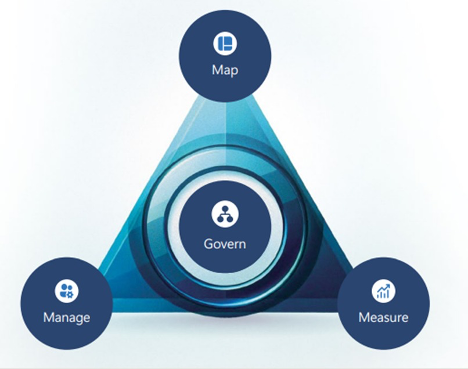
In practice, this means:
- Governance Committees to oversee AI usage and manage risk.
- Data Protection enforced through Microsoft Entra ID, Defender, Purview, and Defender for Cloud Apps.
- AI Policies defining acceptable prompts, data boundaries, and role-based access controls.

Building an AI-Ready Culture
Embedding responsible AI also involves cultural transformation:
- AI Literacy Programs help employees understand the “why” and “how” of generative AI.
- Copilot Champions Networks cultivate peer support and innovation communities.
- Prompt Engineering Workshops empower teams to communicate effectively with AI tools.
Governance isn’t a barrier to innovation, it’s what sustains it.
Sustaining Momentum Through Continuous Improvement
The journey doesn’t end with rollout, it thrives through refinement.
Leading organizations are now establishing Copilot Centers of Excellence (CoEs) to:
- Curate best practices, templates, and training materials.
- Share success stories and measure business impact.
- Govern Copilot lifecycle management updates, integrations, and feedback loops.
- Partner with Microsoft to stay aligned with the evolving Copilot ecosystem.
The CoE acts as the bridge between technology and culture, ensuring every employee, from front-line worker to executive, feels empowered by AI.
Here are some top learnings you can adopt from our experience rolling out Copilot:
- Prepare for change: Accelerate the adoption of Copilot by designing a change management and skilling strategy based on organizations and roles.
- Meet people where they are: Identify groups of employees in specific roles and design skilling activities specific to their roles.
- Encourage ownership: Drive widespread adoption of Copilot by conducting sessions to engage employees and collect feedback.
- Measure the impact: Monitor usage and feedback to understand how Copilot is being used.
- Look ahead: As you deploy Copilot, stay alert to new opportunities for continuous learning, awareness, and productivity enhancement.
Closing Thoughts
The Copilot journey is a marathon, not a sprint. Beyond the initial excitement of pilots lies the deeper work of integration, trust, and continuous evolution.
By expanding Copilot’s reach across departments, building custom AI agents with Copilot Studio, and embedding responsible AI into the organizational ethos, businesses can achieve sustainable, enterprise-grade AI transformationwhere Copilot is no longer a tool, it’s a trusted partner in your digital evolution.